

CRE Daily’s Review of TractIQ
We are honored to share a portion CRE Daily’s review of TractIQ. To read the full review, click here.
Data Coverage and Quality
TractIQ tracks more than 70,000 operating self-storage facilities and development sites nationwide. The platform includes detailed pricing data by unit type for approximately 40,000 facilities and verified owner contact information for more than 45,000 sites.
Demand indicators include extensive demographic data, over 70,000 residential construction projects, more than 300,000 commercial construction projects, traffic counts, and major branded locations such as Walmart, Starbucks, and Whole Foods. Site specific risk factors include flood exposure, sea level rise, seismic risk, and wildfire exposure.
Data is updated daily through a combination of automated processes and expert human review. Every self-storage facility on the platform is reviewed by a qualified analyst. TractIQ provides transparency around data sources and update timing, allowing users to assess data reliability directly.
Verified Operating Performance
Historically, REITs and large operators had the deepest operating insight, but only within their own portfolios. By aggregating verified operating performance across thousands of facilities nationwide, TractIQ delivers a broader operating view than any single portfolio can provide.
TractIQ provides borrower reported facility level occupancy and historic financial performance sourced from CMBS disclosures and institutional filings through its partnership with CRED iQ. This data is relied upon by lenders, ratings agencies, and institutional investors to evaluate credit risk and asset performance and is embedded directly into TractIQ underwriting workflows.
By combining verified operating performance with market context, TractIQ enables users to benchmark real performance against local conditions, identify mispriced risk, and support underwriting assumptions with defensible data suitable for investment committee and lender discussions.
Coverage currently includes several thousand CMBS-reporting facilities, with expansion expected over time as additional institutional data sources are integrated.
Market and Construction Data
TractIQ tracks more than 70,000 residential construction projects and over 300,000 commercial construction sites across the United States. Residential data is updated monthly through municipal partnerships, while commercial construction data spans retail, industrial, education, and medical sectors.
Users can filter by construction type, project status, cost, and proximity and track major brand footprints to identify emerging demand corridors. All datasets can be exported directly into Excel for underwriting models and investment materials.
Deal Identification and Underwriting
TractIQ combines deal sourcing and underwriting within a single, integrated workflow. Users can screen markets and facilities based on criteria such as population growth, income levels, storage saturation, facility attributes, pricing, and future supply.
Users can save facilities, create custom lists, and filter across the entire U.S. facility universe to build prospect and underwriting pipelines aligned with specific investment criteria.
Access to a comprehensive owner database allows users to identify off market opportunities, understand ownership concentration, and prioritize outreach based on portfolio strategy and market conditions.
TractIQ Product Offerings
TractIQ is a robust self-storage data platform offering over 200 datasets designed for in-depth real estate analysis. Its key features include powerful deal identification tools, detailed market insights, and comprehensive construction data, making it an essential resource for investors looking to make informed decisions and stay ahead in the self-storage industry.
Comprehensive platform of self-storage data sets
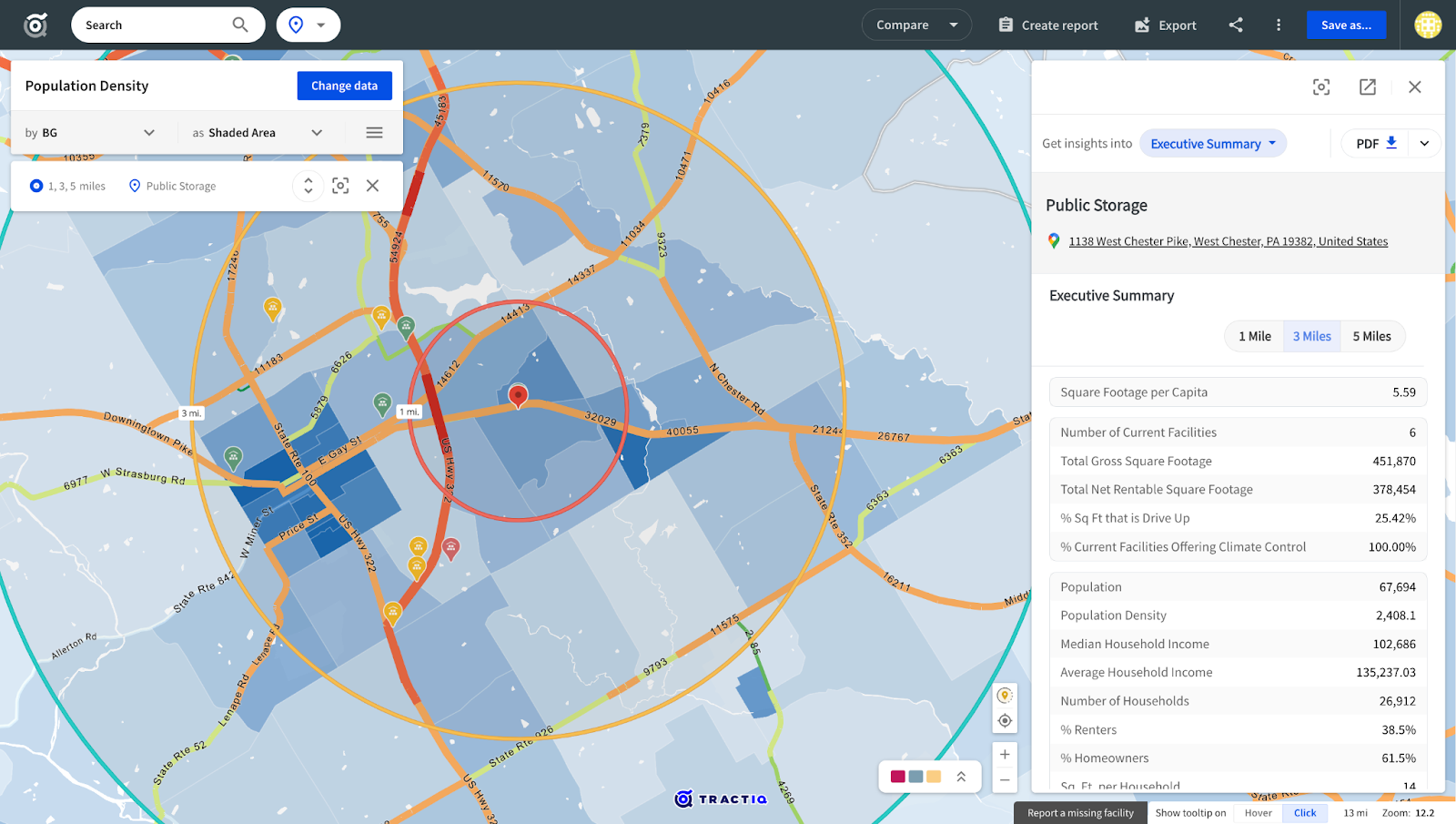
TractIQ empowers leading investors to make smarter investment decisions with verified, transparent data for over 68,000 operating storage facilities and construction sites. The platform includes datasets, including demographics, insurance, FEMA, wildfire information, and incoming housing data. Its advanced export functionality provides committee-ready tables and charts, all backed by trusted public and proprietary data sources, allowing investors to analyze opportunities more efficiently and confidently.
Extensive residential and commercial construction project tracking
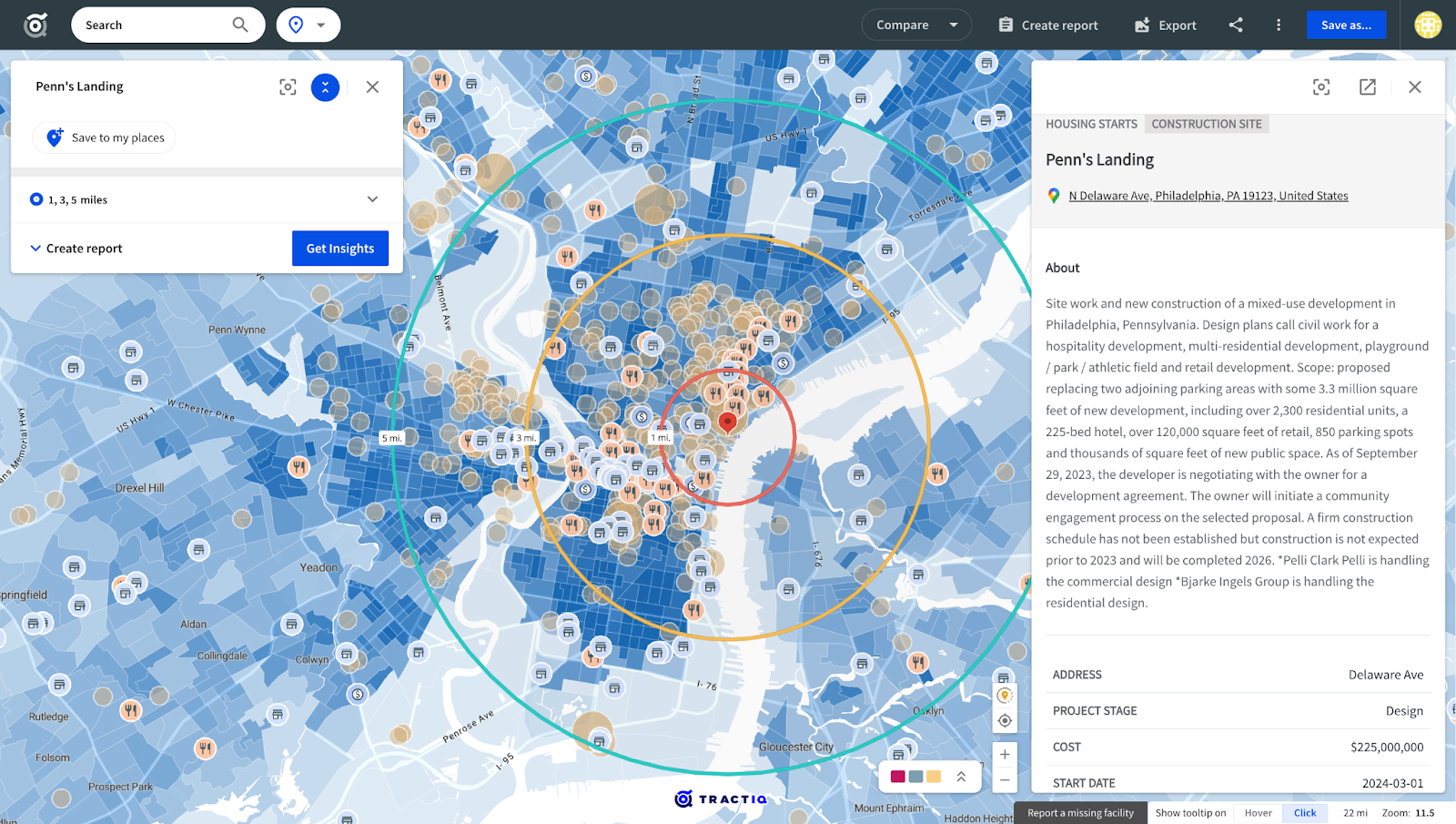
TractIQ partners with multiple sources to gather and update residential construction data from municipalities every month while their team uses advanced technology to track rental rate data for 30,000 self-storage facilities nationwide.
In addition, TractIQ tracks over 300,000 commercial construction sites, providing detailed insights into projects across industries like education, industrial, and retail. Users can filter for specific types of construction, such as retail or medical, and track major brand footprints like Walmart and Starbucks to identify investment opportunities in growing commercial areas. The data can also be exported into Excel.
Deal identification with customizable filters
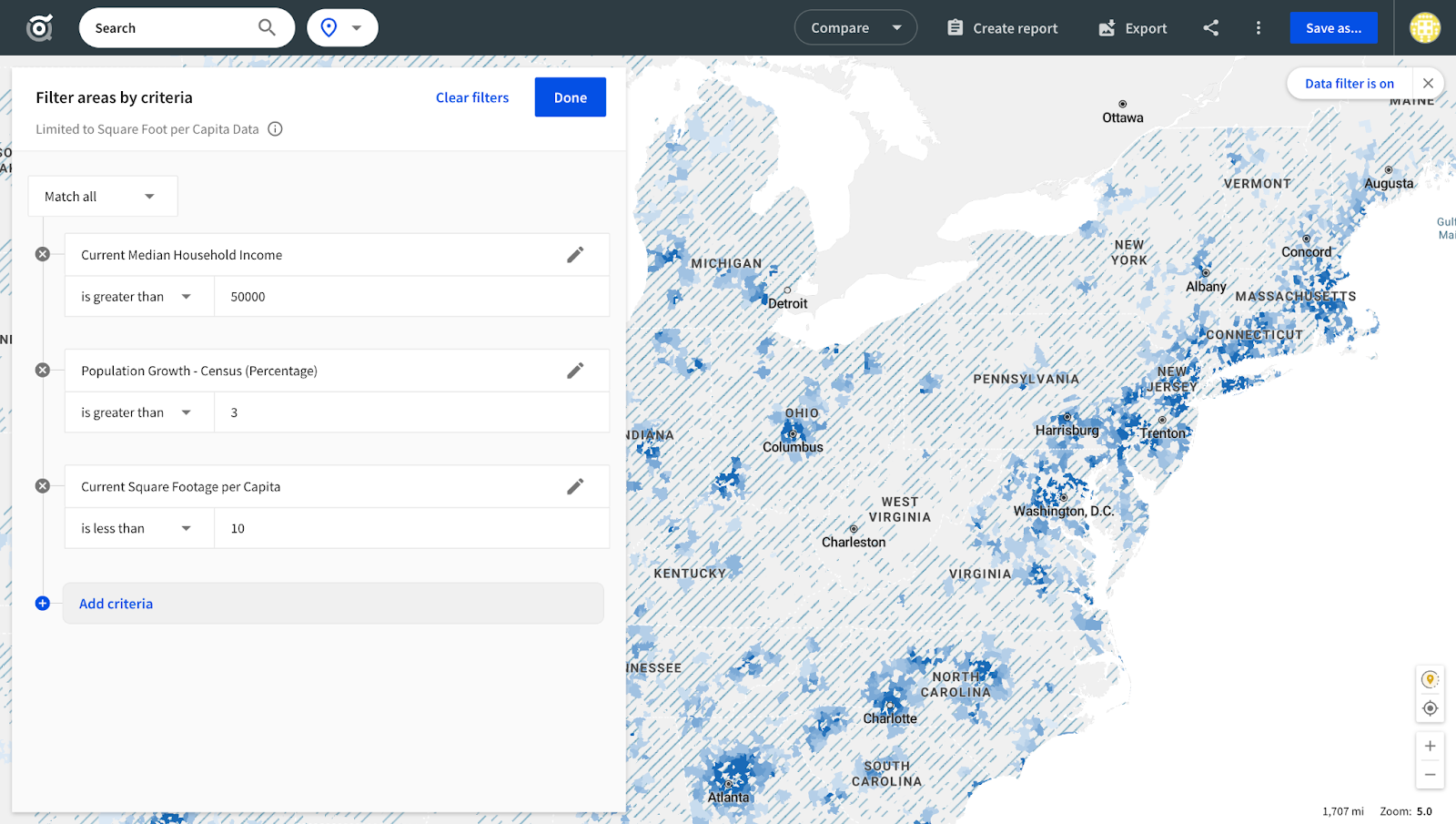
TractIQ offers two primary use cases: efficiently identifying self-storage deals and analyzing them 10x more effectively. The platform allows users to input specific investment criteria, such as population growth, median household income, and storage saturation, to filter down to relevant areas and facilities across the U.S. Users can get granular insights down to the zip code or census tract level, identifying facilities that meet their criteria.
TractIQ also enables filtering by facility attributes like size or rental rates, and users can download comprehensive reports with facility and owner details. This streamlined process empowers investors and brokers to quickly find and evaluate self-storage opportunities.
User Experience
The platform is designed for analytical workflows and allows users to rapidly filter facilities, layer datasets, and generate underwriting ready reports.
For example, users can screen the entire United States for facilities larger than 40,000 square feet with climate controlled rents below a target threshold, then layer in demand criteria such as square feet per capita and population growth to identify off market opportunities aligned with their buy box.
Customer Support
Subscriptions include onboarding resources and recorded training sessions led by TractIQ’s customer success team. Most support inquiries are addressed within one business day. Higher tier plans include dedicated account management and hands on onboarding designed for institutional workflows.
Pricing
- Starter plans start at $199 per month and include core market data and prospecting tools for individual users
- Pro plans start at $399 per month and include expanded data access, higher export limits, and future demand datasets
- Pro+ plans include full historic rate data, access to verified occupancy and financial performance datasets, API access, and dedicated account management
- Nationwide data exports are available for institutional users requiring full U.S. coverage across rents, ownership, demographics, and operating performance.
Competitors
TractIQ’s primary competitors include Yardi Matrix, Radius Plus, and StorTrack, each of which approaches self-storage data from a different angle.
Yardi Matrix
Yardi Matrix is the most widely recognized brand in commercial real estate data and is often the incumbent provider for institutional firms. However, its self-storage dataset covers a more limited portion of the national facility universe relative to TractIQ, making it difficult to analyze markets comprehensively, particularly outside major metros.
Yardi’s self-storage data is also offered as a standalone product, meaning users seeking multi asset context must purchase additional subscriptions. This fragmented approach can increase complexity and total cost for users underwriting across portfolios or regions.
Radius Plus
Radius Plus uses a credit based access model that allows short term platform usage, which may appeal to occasional users. However, the platform does not currently include several datasets relied upon for institutional underwriting, including verified occupancy and financial performance and detailed residential and commercial construction data.
As a result, Radius Plus is often better suited for high level screening rather than full underwriting workflows that require deep market context, performance benchmarking, and exportable data for investment committee review.
StorTrack
StorTrack offers broad facility coverage and is often viewed as the closest alternative to TractIQ in terms of scale. However, its data offering focuses primarily on pricing and facility attributes and does not include verified operating performance or comprehensive demand side datasets such as residential and commercial construction activity.
StorTrack also lacks certain risk and location specific datasets, including traffic counts and flood exposure, which are increasingly important for evaluating site level risk and development feasibility.
Competitive Positioning
What was once a competitive advantage is increasingly becoming table stakes for institutional self-storage underwriting as performance data becomes visible at scale.
Relative to these platforms, TractIQ combines national scale, verified facility level operating performance, and extensive market and demand context within a single underwriting workflow. This integrated approach reduces reliance on proxy signals and enables more defensible, institution ready underwriting suitable for investment committee and lender review.
