
Q4 2025 REIT Data Download
FREE DOWNLOAD
10 Years of Self-Storage REIT Performance Data
Here’s what’s inside 👇
→ Quarterly data from Q1 2015 to Q4 2025
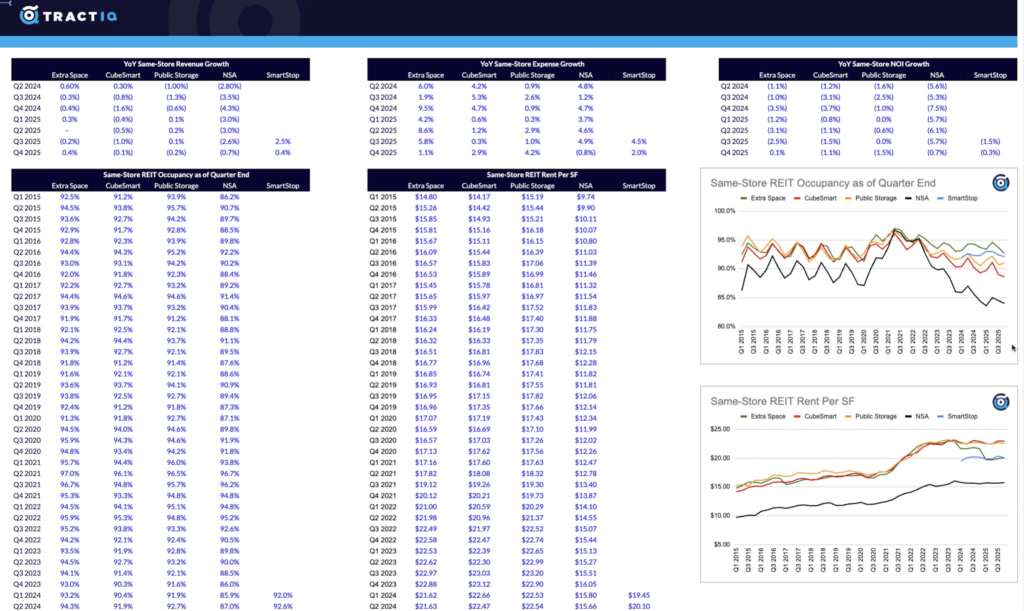
→ Achieved rent per SF and same-store occupancy for Extra Space Storage, CubeSmart, Public Storage, NSA Storage (pre-acquisition), and SmartStop Self Storage
→ Same-store revenue growth, expense growth, and NOI growth by REIT
The results?
→ Q4 2025 occupancy ranged from 84.0% to 92.6% across the major public self-storage REITs
→ Achieved rent per SF in Q4 2025 ranged from $15.76 to $22.95
→ Same-store NOI growth in Q4 2025 ranged from +0.1% at Extra Space to -1.5% at Public Storage
We put the full dataset into a clean spreadsheet that’s ready to plug into your models.
Data Details
The dataset tracks four of the most critical same-store performance metrics in the industry, reported by REIT and by quarter. Year-over-year same-store revenue growth shows how each operator expanded or contracted its top line over the last 7 quarters. Year-over-year same-store expense growth highlights how effectively operators managed costs over the last 7 quarters. Same-store occupancy at quarter end provides a clear view of utilization trends across market cycles, from pre-pandemic stability to recent supply-driven softening. Same-store rent per square foot documents rent trajectory over time, giving you a grounded benchmark for validating current and forward-looking pricing assumptions.
Download the Q4 2025 REIT Performance Report and benchmark your portfolio against the leading operators in self-storage.
Why This Data Is Uniquely Valuable
REIT earnings reports are fragmented across filings, inconsistently formatted, and time-intensive to compile. TractIQ has standardized and organized this information into a single, analyst-ready dataset. Built-in charts allow for immediate comparison of occupancy and rent trends across all five operators.
For institutional investors and portfolio managers, this dataset serves as a market cycle roadmap, illustrating how the sector performs across varying economic conditions and identifying which operators have delivered consistent results. For brokers and advisors, it strengthens positioning with clients by grounding recommendations in long-term, REIT-level data. For owners and operators, it provides a clear benchmark against top-performing portfolios, helping identify gaps and opportunities within existing assets. For acquisition and development teams, it adds essential macro context to complement deal-level underwriting and inform long-term strategy.
